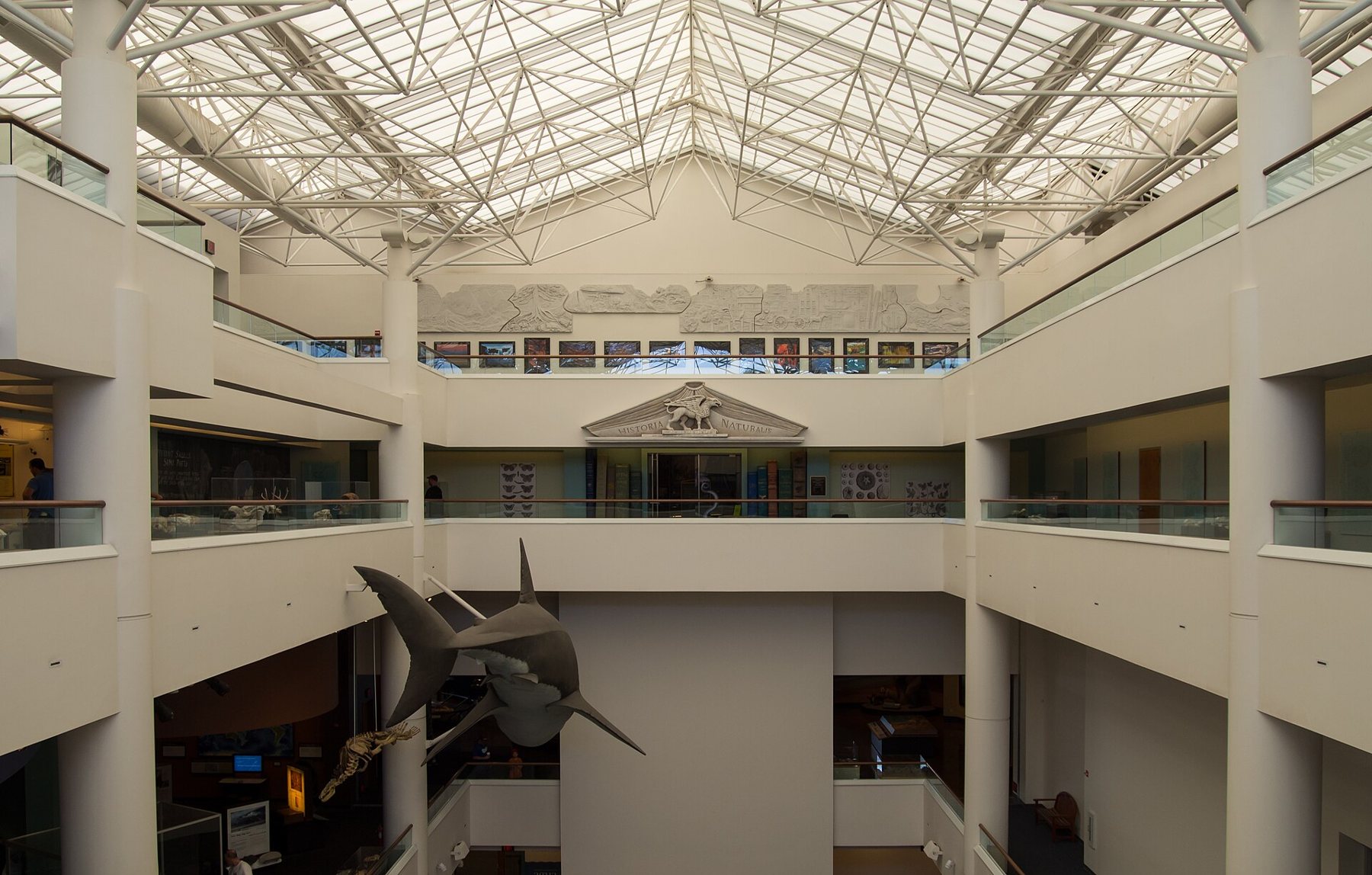
Kids who love dinosaurs tend to love them with real intensity, and the San Diego Natural History Museum in Balboa Park gives that love somewhere to go. Known locally as The Nat, the museum looks at the natural world of Southern California and Baja California, and its fossil exhibition tells the long story of the land under your feet: ancient seas, shifting coastlines, giant mammals and creatures that lived here long before any people.
For school-age children, roughly five to eleven, it is a near-perfect few hours. There is enough to fill a morning, it works in any weather, and when everyone is done, Balboa Park's lawns are right outside for lunch.
The fossil exhibition, floor by floor
The fossil exhibition is the reason most families come. Rather than one hall of famous skeletons from far away, it follows Southern California's past through time, from deep history to the much more recent Ice Age. Kids walk through it like a story, with fossils, casts, models and hands-on stations along the way.
A few things to watch for with kids:
- Sea creatures. Much of the region was under the ocean for long stretches of its history. Marine reptiles, ancient sharks and early whales tend to amaze children who assumed everything prehistoric was a dinosaur.
- Local finds. Many fossils from the San Diego area turned up during road building and construction, when digging exposed old rock layers. Kids like knowing that a fossil came from a place they might drive past.
- Ice Age giants. Large mammals that once roamed the region help bridge the gap between dinosaurs and the animals children know today.
- Working scientists. Depending on the day, there may be a window or area where you can see fossil preparation work. Not every visit will have someone working, but it is worth a look.
Exhibits change over time, so check the museum's own website for what is open before you go.
How to pace it with school-age kids
Museums wear out children faster than playgrounds do. The trick is to arrive with a plan and leave before the energy runs out.
The trick is to arrive with a plan and leave before the energy runs out.
- Start with the fossils. Go straight to the main attraction while attention is high. Everything else can come after.
- Give each child a job. One finds the biggest tooth, one finds the oldest fossil, one counts the sea creatures. A mission turns wandering into searching.
- Take a break halfway. Sit down on a bench, have a drink, compare discoveries.
- Add one more area. The museum has other galleries on the region's animals and plants, and some families like to finish in a different room for a change of pace.
- Stop while it is still fun. Two hours is plenty for many kids. You can always come back.
Younger siblings can come too. The building has elevators and wide floors, so a stroller is easy, and toddlers often enjoy the big models even if the timeline is lost on them.
5-11The science center's push-buttons, and how to pace themMaking the most of the trip
Talk about time
Deep time is hard to grasp. A simple trick: stretch your arms wide and say one hand is the oldest fossil and the other is today. People arrive somewhere near the very tip of your fingernail. Kids remember that long after they forget the names of the fossils.
Bring a notebook
A small notebook and a pencil let a child sketch a skull, copy a name or write down a question to look up later. Drawing slows kids down in a good way, and many of them will happily sit on the floor to finish a picture.
Ask the staff
Museum staff and volunteers are usually happy to talk to curious kids. A child who asks a real question often gets a better answer than any sign could give.
Match it to the age
Five- and six-year-olds mostly want size and teeth: the biggest skull, the sharpest claws, the longest neck. Let them have that, and do not worry about the timeline. Seven- to nine-year-olds start to enjoy sorting and comparing, so ask which animal lived first and which came later. Ten- and eleven-year-olds can handle the bigger ideas: why the sea covered the land, how a bone turns to stone, and how scientists can tell what an animal ate from its teeth. The same exhibition works for all three, as long as you change the questions.
For a child who leaves wanting more, the public library is a good next stop. Books on fossils and ancient life keep the interest going until the next visit.
Tickets, residents' days and parking
Tickets cost money, and prices change. Check the museum's own website before you go. The museum, like others in Balboa Park, has taken part in a residents' free day program that lets San Diego city and county residents visit selected museums free on certain Tuesdays each month, with a rotating schedule. Bring proof of residence if you plan to use it, and expect bigger crowds on those days. Details change, so check before you go.
Balboa Park parking has changed in recent years, with paid lots and different rules in different areas. Check the park's own website for the current arrangements, and arrive early on weekends. Buses also serve the park from downtown.
Museums keep their own hours and may close on some weekdays. Check the day you plan to visit, especially in school holidays when hours and crowds can change.
A picnic on the lawns, and what comes next
When the museum is done, step outside. The lawns and shady areas of Balboa Park are a short walk away, and a picnic on the grass is a good reward for a morning of looking. The Bea Evenson Fountain sits right by the museum, and kids love watching its jets rise and fall. Keep them out of the water itself.
From here, the rest of Balboa Park is close at hand. Science-minded kids will want to cross the plaza to the science center's push-buttons, and train fans can head to the model railroad rooms under the park. Younger siblings who need a short treat can finish at the carousel and the little train. On a rare wet day, this museum anchors a solid rainy-day plan for every age, and for fossil fans ready to see rocks in the wild, the cliffs and trails of the coast are waiting when they are older.
The best measure of a visit like this is simple: a child who walks out still asking questions. If the drive home is full of talk about ancient sharks and Ice Age giants, the morning did its job.